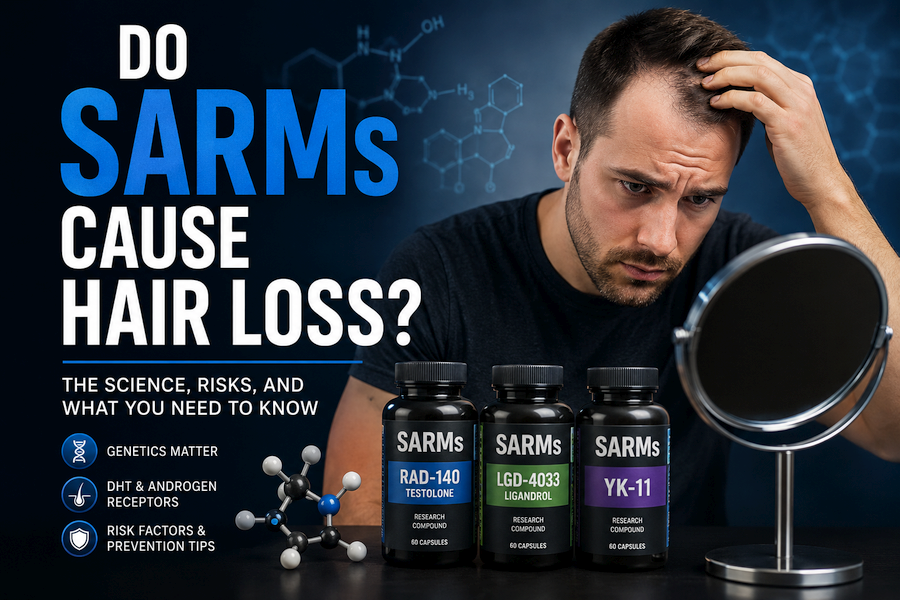
Yes, SARMs may cause hair loss in some users, especially those who are genetically prone to male pattern baldness. While SARMs are often marketed as a safer alternative to anabolic steroids, some compounds appear more likely to contribute to hair shedding than others. SARMs such as RAD-140, YK-11, and LGD-4033 are frequently associated with reports of hair loss, while milder compounds like Ostarine may carry a lower risk. Genetics, dosage, cycle length, and individual hormone sensitivity all play a role.
SARMs – The Safer Alternative to Steroids?
Selective Androgen Receptor Modulators, better known as SARMs, are compounds designed to selectively activate androgen receptors in muscle and bone tissue. Their original purpose was to help treat conditions such as muscle wasting, osteoporosis, and age-related muscle loss.
Bodybuilders and fitness enthusiasts became interested in SARMs because they promised some of the muscle-building benefits of anabolic steroids without many of the harsh side effects. That sounds great on paper. The reality is a bit more complicated.
Although SARMs are generally considered more selective than traditional steroids, they still interact with the body’s hormonal system. Once hormones get involved, unexpected side effects can happen.
One question that comes up repeatedly is whether SARMs can make your hair fall out. The short answer is that they can.
Why Hair Loss Happens in the First Place
To understand why SARMs may contribute to hair loss, it helps to understand how male pattern baldness works.
Most cases of male hair loss are linked to a hormone called dihydrotestosterone, or DHT. DHT is created when testosterone is converted by an enzyme known as 5-alpha reductase.
In men who are genetically susceptible, DHT attaches to receptors in hair follicles. Over time, these follicles shrink. Hair becomes thinner, weaker, and eventually stops growing altogether (1).
Not every man is equally vulnerable. Some men maintain a full head of hair into their 70s despite high hormone levels. Others begin losing their hair in their early 20s.
Genetics appear to be the biggest factor. This is important because SARMs don’t necessarily increase DHT directly like some steroids do. Yet many users still report hair shedding. So what’s going on?
How SARMs May Cause Hair Loss
The exact mechanism isn’t completely understood. Research on SARMs remains limited compared to testosterone and anabolic steroids. Most of what we know comes from clinical studies, hormonal analysis, and large numbers of user reports.
Several theories may explain why SARMs appear to contribute to hair loss.

Increased Androgen Activity
SARMs activate androgen receptors. Hair follicles contain androgen receptors as well.
Even though SARMs are designed to target muscle and bone more selectively, they aren’t perfectly selective. Some compounds may still stimulate androgen receptors in scalp tissue enough to accelerate hair miniaturization in genetically susceptible individuals (2).
Hormonal Imbalances
SARMs can suppress natural testosterone production. When hormone levels shift, the balance between testosterone, estrogen, DHT, and other hormones can become disrupted.
These hormonal fluctuations may create an environment that encourages shedding or accelerates existing male pattern baldness.
If you’ve read our guide on how to lower SHBG, you already know that even relatively small hormonal changes can influence how much free androgen activity occurs in the body.
Existing Genetic Predisposition
This may be the most important factor of all. Many users who report hair loss from SARMs already have a family history of baldness.
In these cases, SARMs may not actually create a new problem. Instead, they may speed up a process that was already going to happen. Think of it as hitting the fast-forward button.
Which SARMs Are Most Likely to Cause Hair Loss?
Not all SARMs appear equally risky. Some compounds are repeatedly mentioned in hair loss discussions, while others seem less problematic.
Here’s a general overview.
| SARM | Hair Loss Risk |
|---|---|
| Ostarine (MK-2866) | Low to Moderate |
| LGD-4033 (Ligandrol) | Moderate |
| RAD-140 (Testolone) | Moderate to High |
| YK-11 | High |
| Andarine (S4) | Moderate |
| MK-677* | Very Low |
*MK-677 is not technically a SARM.

RAD-140 (Testolone)
RAD-140 is widely considered one of the strongest SARMs currently available. Because of its potency, it also appears more likely to cause androgenic side effects.
Many anecdotal reports describe increased shedding during RAD-140 cycles. While anecdotal evidence isn’t the same as clinical research, the consistency of these reports is difficult to ignore.
YK-11
YK-11 occupies a strange category. Technically, many experts don’t consider it a true SARM. Its structure and behavior share some characteristics with anabolic steroids.
Because of its potent androgenic activity, YK-11 is frequently associated with hair loss complaints.
LGD-4033
LGD-4033 is another popular bulking compound. It appears capable of producing substantial muscle gains, but users occasionally report thinning hair, especially at higher dosages or during longer cycles.
Ostarine
Ostarine is generally viewed as one of the milder SARMs. Hair loss reports exist, but they seem less common compared to RAD-140 or YK-11.
That doesn’t mean Ostarine is completely safe for your hair. If you’re highly sensitive to androgenic changes, even a milder compound could potentially trigger shedding.
Is SARMs Hair Loss Permanent?
That’s one of the biggest concerns users have. The answer depends on what’s actually causing the shedding.
If SARMs trigger a temporary condition known as telogen effluvium, hair may regrow once hormone levels return to normal. On the other hand, if SARMs accelerate androgenic alopecia (male pattern baldness), the loss may be permanent.
Unfortunately, it isn’t always easy to tell the difference right away.
Temporary shedding often occurs throughout the scalp and may improve within several months after stopping the compound. Male pattern baldness usually follows recognizable patterns, such as a receding hairline or thinning at the crown.
If hair follicles become fully miniaturized, regrowth becomes much more difficult.
What Does the Research Say?
Research specifically examining SARMs and hair loss remains surprisingly limited. Most clinical trials focus on muscle mass, strength, bone density, and safety markers rather than cosmetic side effects.
However, researchers acknowledge that androgen receptor activation can potentially produce androgenic side effects, including acne, oily skin, and hair loss in susceptible individuals (3).
One challenge is that many recreational users take dosages significantly higher than those studied in clinical settings. As a result, real-world side effects may not always match published research findings.
That’s one reason why anecdotal evidence from large user communities remains relevant, even though it should be interpreted cautiously.
Factors That Increase Your Risk
Not everyone experiences hair loss while using SARMs. Several factors seem to increase risk.
Family History of Baldness
If your father, grandfather, or brothers experienced male pattern baldness, your risk is probably higher. Genetics matter far more than many people realize.
Higher Dosages
More isn’t always better. Higher doses generally increase androgen receptor activation and hormonal disruption, which may raise the likelihood of side effects.
Longer Cycles
Running SARMs for 12 to 16 weeks instead of 6 to 8 weeks may increase cumulative exposure. That additional exposure could increase the chance of hair shedding.
Stacking Multiple Compounds
Many users combine multiple SARMs together. The more compounds involved, the harder it becomes to predict hormonal effects.
Hair loss risk may increase as overall androgenic activity rises.

Can You Prevent Hair Loss While Using SARMs?
There are no guarantees. Still, some strategies may help reduce risk.
Use Conservative Dosages
One of the simplest approaches is avoiding excessive doses. Many side effects appear dose-dependent.
Using the lowest effective dose may help minimize unwanted consequences.
Limit Cycle Length
Shorter cycles may reduce cumulative exposure. Again, this doesn’t eliminate risk, but it may lower it.
Maintain Overall Hair Health
Good nutrition supports healthy hair growth. Deficiencies in iron, zinc, protein, vitamin D, and other nutrients can contribute to hair thinning independently of SARMs (4).
Consider Hair Loss Treatments
Some users turn to treatments such as minoxidil or finasteride. These medications have their own benefits and risks.
Finasteride, in particular, reduces DHT levels and may help slow male pattern baldness. However, some users experience side effects that make them reluctant to use it.
Anyone considering prescription medications should discuss the decision with a healthcare professional.
Are SARMs Safer for Hair Than Steroids?
Generally speaking, yes. Most anabolic steroids carry a much higher risk of androgenic side effects.
Compounds derived from DHT, such as Winstrol and Masteron, are particularly notorious for accelerating hair loss in genetically susceptible men (5). SARMs were designed to reduce these kinds of unwanted effects.
That said, “safer” doesn’t mean “risk-free.” Some marketing claims make SARMs sound almost side-effect free. The available evidence simply doesn’t support that idea.
Hair loss, testosterone suppression, lipid changes, and other issues remain possible. If you’re interested in a broader safety comparison, our article on SARMs or Steroids: Which Is Safer? explores the topic in detail.

Should You Avoid SARMs If You’re Concerned About Hair Loss?
That depends on your priorities. For some people, gaining a few pounds of muscle is worth accepting a certain amount of risk.
For others, preserving their hair is far more important. Neither position is right or wrong.
Personally, if I already had signs of a receding hairline and a strong family history of baldness, I’d think very carefully before using potent SARMs like RAD-140 or YK-11. The potential muscle gains might not outweigh the possibility of speeding up a lifelong cosmetic issue.
On the other hand, someone with excellent hair genetics may never notice any shedding at all. The challenge is that nobody knows with certainty how they’ll respond until they try.


Jim is the founder of Andro HQ and a self-taught supplement reviewer with over 12 years of personal testing experience. He has evaluated more than 150 bodybuilding products and specializes in identifying effective, science-backed alternatives to banned substances. His insights are grounded in real-world use, documented trials, and continuous experimentation in the gym. While not a licensed health professional, Jim aims to help readers navigate the often-confusing supplement market through honest, evidence-informed reviews. More about this author…