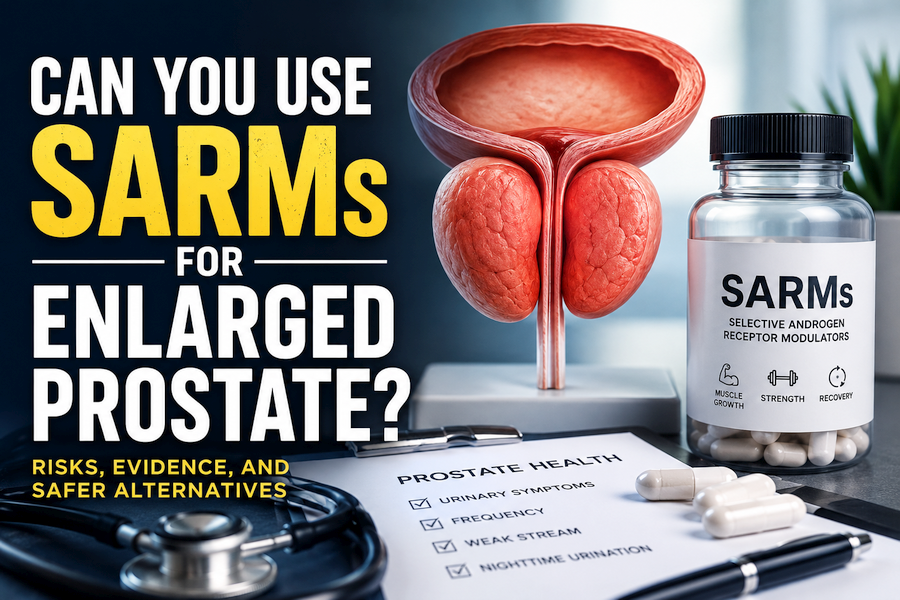
Probably not, at least not as a treatment. There is currently no good clinical evidence showing that SARMs (Selective Androgen Receptor Modulators) can treat an enlarged prostate, also known as benign prostatic hyperplasia (BPH). In fact, because SARMs interact with androgen receptors, some experts believe they could potentially affect prostate tissue in ways that aren’t yet fully understood. If you have BPH or bothersome urinary symptoms, it’s generally wiser to stick with treatments that have been studied and approved for that condition rather than experimenting with SARMs. (1,2)
An enlarged prostate becomes increasingly common as men get older. By age 60, many men notice weaker urine flow, frequent nighttime bathroom trips, or the frustrating feeling that their bladder never completely empties. At the same time, SARMs have become popular among bodybuilders and fitness enthusiasts looking to build muscle without using traditional anabolic steroids.
That overlap raises an interesting question: Can you safely use SARMs if you already have an enlarged prostate? Or could they actually make the condition worse?
The answer isn’t as straightforward as many people would like. While SARMs were designed to target muscle and bone more selectively than testosterone, they’re still experimental compounds. Researchers are continuing to learn how they affect different organs, including the prostate.
A SARMs Refresher
SARMs, or Selective Androgen Receptor Modulators, are compounds that bind to androgen receptors throughout the body. Their main appeal is that they’re intended to stimulate muscle and bone growth while causing fewer unwanted effects than anabolic steroids.
Unlike testosterone, which affects many tissues, SARMs appear to activate androgen receptors more selectively. That’s why they’ve attracted attention for conditions involving muscle wasting, osteoporosis, and age-related loss of muscle mass. (3)
Some of the better-known SARMs include:
- Ostarine (MK-2866)
- Ligandrol (LGD-4033)
- RAD-140 (Testolone)
- YK-11
- Andarine (S4)
Despite their popularity online, it’s worth remembering that no SARM has been approved by the U.S. Food and Drug Administration for recreational bodybuilding. Many products sold online also contain inaccurate ingredient amounts or substances that aren’t listed on the label. (4)
If you’re new to these compounds, you might also find our guide to SARMs Usage, Benefits, Risks, & Legality helpful, along with our comparison of SARMs vs. Peptides, both of which explain how these compounds differ from other performance-enhancing options.

What Happens With an Enlarged Prostate?
An enlarged prostate, medically called benign prostatic hyperplasia (BPH), is a non-cancerous increase in the size of the prostate gland. The prostate surrounds part of the urethra, the tube that carries urine out of the body. As the gland enlarges, it can squeeze the urethra and make urination more difficult.
Common symptoms include:
- A weak urine stream
- Difficulty starting urination
- Frequent urination, especially at night
- A sudden urge to urinate
- Dribbling after urination
- Feeling that the bladder isn’t completely empty
Although hormones play a role in BPH, the condition is more complicated than simply having “too much testosterone.” Aging, chronic inflammation, genetics, and the activity of dihydrotestosterone (DHT) all appear to contribute. (5)
Do SARMs Affect the Prostate?
This is where things become less certain. SARMs were originally developed with the hope that they would stimulate muscle growth while having less effect on tissues like the prostate. Animal studies and early human research have shown that some SARMs appear to produce less prostate stimulation than testosterone itself. (6)
That sounds encouraging at first glance. The problem is that “less stimulation” doesn’t necessarily mean “no stimulation.”
The prostate contains androgen receptors, and SARMs are specifically designed to activate those receptors. Different SARMs also behave differently, so it’s difficult to make broad statements about the entire class.
Most importantly, researchers still lack long-term human studies involving men with existing BPH. Because of that, nobody can confidently say whether using SARMs is harmless, beneficial, or potentially risky for men with enlarged prostates.
In other words, the absence of evidence isn’t the same thing as evidence of safety.
Could SARMs Make BPH Worse?
It’s certainly possible, although the available research doesn’t provide a definitive answer. Many doctors take a cautious approach because androgen signaling influences prostate tissue. Even if SARMs don’t convert into DHT the same way testosterone does, they still activate androgen receptors to varying degrees. That could theoretically influence prostate growth or urinary symptoms in susceptible individuals. (2,6)
There’s another issue that’s often overlooked. Some SARMs suppress your body’s natural testosterone production. During recovery, hormone levels can fluctuate considerably, especially if post-cycle therapy isn’t handled properly. Those hormonal shifts may indirectly influence prostate health, although this hasn’t been studied well in men with BPH. (7)
Our article on Natural PCT Supplements explains why hormonal recovery can become an important consideration after a SARM cycle.
What Does the Research Actually Show?
One of the biggest limitations is the lack of long-term clinical data. Most human SARM studies were designed to investigate muscle wasting, frailty, or osteoporosis—not prostate disease. These trials generally involved relatively small numbers of participants and short treatment periods. They weren’t intended to determine whether SARMs are safe for men with existing BPH. (3)
Some preclinical research has suggested that certain SARMs may increase muscle and bone without causing the same degree of prostate enlargement seen with testosterone. That’s one reason pharmaceutical companies originally became interested in developing them. (6)
Still, promising laboratory findings don’t always translate into real-world outcomes. A compound may behave one way in animals or healthy volunteers and quite differently in older men who already have prostate enlargement, multiple medical conditions, or are taking medications for urinary symptoms.
That’s why many urologists would likely recommend caution rather than optimism until better evidence becomes available.
One practical point is easy to overlook: if you begin a SARM cycle and your urinary symptoms suddenly become worse, there’s no reliable way to know whether the compound contributed. At that stage, stopping the cycle and speaking with your healthcare provider would generally be the safest course of action.
Which SARMs May Pose a Greater Concern?
Unfortunately, there’s no clear ranking of SARMs based on prostate safety. That’s because the necessary long-term studies simply haven’t been done.
That said, more potent SARMs like RAD-140 (Testolone) and LGD-4033 (Ligandrol) generally produce stronger anabolic effects than milder compounds such as Ostarine (MK-2866). Whether that translates into greater prostate stimulation isn’t known, but some researchers believe it could be a reasonable concern until better evidence becomes available. (6)
Another complication is product quality. Independent testing has repeatedly found that many products marketed as SARMs don’t actually contain what the label claims. Some contain multiple SARMs, while others have been contaminated with anabolic steroids or completely different drugs. (4)
For someone already dealing with BPH, that’s an unnecessary gamble. You may think you’re taking one compound when you’re actually exposing yourself to something much more androgenic.
If you’re considering a specific compound, our guides to RAD-140 (Testolone), LGD-4033 (Ligandrol), and Ostarine (MK-2866) explain their potential benefits, risks, and side effects in greater detail.
Are SARMs Ever Used to Treat an Enlarged Prostate?
No. While SARMs have been investigated for conditions such as muscle loss, osteoporosis, and physical frailty, they are not approved or recommended for treating benign prostatic hyperplasia. (3)
Current BPH treatments are aimed at improving urine flow or reducing prostate size. Depending on the severity of symptoms, your doctor may recommend:
- Lifestyle changes, such as reducing evening fluid intake or limiting caffeine and alcohol.
- Alpha-blockers that relax the muscles around the bladder neck.
- 5-alpha reductase inhibitors, which lower DHT levels and may gradually shrink the prostate.
- Minimally invasive procedures or surgery if symptoms become severe. (1,5)
These treatments have been studied extensively in men with BPH. SARMs haven’t.
What If You Already Have BPH and Want to Build Muscle?
That can be frustrating, especially if you’re finding it harder to maintain muscle as you get older. The good news is that you don’t necessarily need SARMs to make meaningful progress.
For many men, focusing on the fundamentals produces surprisingly good results:
- Follow a structured resistance training program.
- Eat enough high-quality protein throughout the day.
- Get adequate sleep and recovery.
- Maintain a healthy body weight.
- Address low testosterone if it’s confirmed by blood testing and managed by a physician.
If low testosterone is contributing to muscle loss, fatigue, or reduced strength, it’s much safer to work with a healthcare provider than to self-medicate with experimental compounds.
You might also consider reading our guides on Best Workout Supplements for Men Over 40 and TRT: Testosterone Replacement Therapy Guide if you’re exploring evidence-based ways to support muscle and strength as you age.

Should Men With BPH Avoid SARMs?
Based on what we currently know, a cautious approach makes sense. SARMs may eventually prove to have a relatively small effect on prostate tissue, or researchers may identify specific compounds that are safer than others. At the moment, however, the evidence simply isn’t strong enough to make that claim.
If you already have an enlarged prostate, frequent urination, poor urine flow, or elevated PSA levels, experimenting with SARMs is unlikely to be worth the uncertainty. Even if they don’t directly worsen BPH, they may complicate your doctor’s ability to evaluate new urinary symptoms or changes in prostate health.
Another point worth considering is that many men interested in SARMs are over 40 – the same age group in which BPH becomes increasingly common. That makes prostate health something that shouldn’t be treated as an afterthought.


Jim is the founder of Andro HQ and a self-taught supplement reviewer with over 12 years of personal testing experience. He has evaluated more than 150 bodybuilding products and specializes in identifying effective, science-backed alternatives to banned substances. His insights are grounded in real-world use, documented trials, and continuous experimentation in the gym. While not a licensed health professional, Jim aims to help readers navigate the often-confusing supplement market through honest, evidence-informed reviews. More about this author…