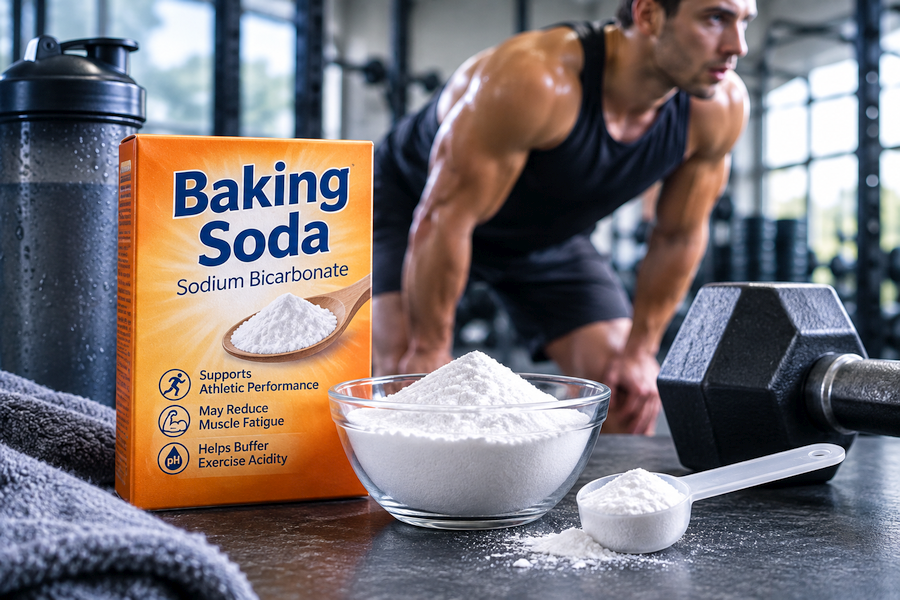
Baking soda, also known as sodium bicarbonate, may improve performance during short, intense exercise by helping your body manage the rise in acidity that contributes to fatigue. Research suggests it can be particularly useful for activities lasting roughly 30 seconds to 12 minutes, including hard cycling, rowing, swimming, running, and some forms of resistance training. A commonly studied dose is around 0.3 grams per kilogram of body weight, usually taken 60–180 minutes before exercise. The biggest drawback is stomach trouble, which can be significant for some people.
When you think about sports supplements, baking soda probably isn’t the first thing that comes to mind. It’s more likely sitting in your kitchen cabinet than next to your creatine and protein powder.
Yet sodium bicarbonate has been studied as a performance aid for decades. In fact, there’s enough evidence behind it that the International Society of Sports Nutrition (ISSN) recognizes sodium bicarbonate as an effective supplement for certain types of exercise (1).
That doesn’t mean a spoonful of baking soda will suddenly turn you into a better athlete. Its benefits are fairly specific, and the side effects can sometimes outweigh them. Still, for the right type of training, sodium bicarbonate is surprisingly interesting.
How Does Baking Soda Improve Athletic Performance?
During intense exercise, your muscles rely heavily on anaerobic energy production. As exercise intensity rises, hydrogen ions accumulate within working muscle, contributing to a drop in muscle pH.
People often blame “lactic acid” for the burning sensation and fatigue that come with hard exercise. That’s an oversimplification. Lactate itself isn’t simply a waste product causing your muscles to fail. The changes in acidity that accompany intense energy production are more relevant to declining muscle function.
This is where sodium bicarbonate comes in. Bicarbonate acts as a buffer. Taking enough sodium bicarbonate raises bicarbonate levels in the blood and makes the extracellular environment more alkaline. That creates a greater gradient for hydrogen ions to move out of working muscle cells (1).
In practical terms, your muscles may be able to tolerate intense work a little longer before fatigue forces you to slow down.
It’s somewhat similar in concept to beta-alanine, although the two work differently. Beta-alanine increases carnosine inside muscle cells, while bicarbonate primarily increases buffering outside them. If you’re interested in other compounds used for intense training, our guide to the top pre-workout ingredients covers several popular options.

Baking Soda May Improve High-Intensity Exercise
The strongest case for sodium bicarbonate involves high-intensity exercise lasting roughly 30 seconds to 12 minutes. The ISSN reports potential benefits for cycling, running, swimming, rowing, muscular endurance, and several combat sports (1).
An umbrella review examining previous meta-analyses came to a similar conclusion. Researchers found evidence that sodium bicarbonate may improve anaerobic capacity, peak power, high-intensity intermittent running, muscular endurance, and exercise lasting around 45 seconds to eight minutes (2).
Not every study produces impressive results, though. Some benefits are modest, and the quality of evidence varies between different types of exercise. That’s worth remembering. Baking soda isn’t comparable to a stimulant where you immediately “feel” more energetic. Even when it works, the difference may only be a few percent.
For a competitive athlete, however, a few percent can matter quite a lot.
It May Help You Sustain Hard Efforts Longer
One of sodium bicarbonate’s more interesting effects is its potential influence on time to exhaustion. A systematic review and meta-analysis found that bicarbonate supplementation significantly improved time-to-exhaustion performance, although it didn’t produce a significant improvement in time-trial performance in that particular analysis (3).
This distinction makes sense. Bicarbonate probably won’t do much when you’re exercising comfortably below your limits. Its advantage becomes more relevant when exercise creates enough metabolic stress that buffering capacity starts limiting performance. Think hard intervals, repeated sets, a brutal rowing effort, or the final portion of a race.
For athletes interested in other ways nutrition can influence performance, our article on caffeine for bodybuilding and athletic performance covers another well-established ergogenic aid.
Baking Soda Could Benefit Cycling, Rowing, and Swimming
Several sports appear particularly well suited to bicarbonate supplementation. A meta-analysis of cycling time trials found improvements in both mean power output and performance time following sodium bicarbonate ingestion (4). Interestingly, individualized timing based on when blood bicarbonate peaked appeared useful.
Swimming research has produced similarly interesting results. A meta-analysis found no meaningful benefit across all swimming distances combined, but sodium bicarbonate improved performance by about 1.3% in 200- and 400-meter events (5).
A 1.3% improvement doesn’t sound dramatic. In competitive sports, though, races are frequently decided by much smaller margins.
Rowers may also benefit, particularly in 2,000-meter events, which combine high power output with several minutes of sustained effort (2). These examples highlight the sweet spot for bicarbonate: exercise that’s intense enough to create substantial metabolic stress but long enough for fatigue from that stress to become important.

What About Weight Training?
Baking soda may have some value in the gym as well. The ISSN concluded that sodium bicarbonate can improve muscular endurance (1). In resistance training, that might translate into squeezing out extra repetitions during demanding sets or maintaining performance across repeated sets.
Don’t expect it to instantly increase your one-rep max. Evidence for improvements in maximum strength isn’t particularly convincing (2). Its potential advantage is more likely to show up during high-volume bodybuilding workouts, circuits, or repeated sets taken close to failure.
Of course, being able to perform slightly more training volume could theoretically support muscle growth over time. That’s an indirect benefit rather than proof that baking soda itself builds muscle. For more on the nutrition side of hypertrophy, see our guide to timing protein intake for muscle growth.
How Much Baking Soda Do Athletes Take?
Sports research usually calculates sodium bicarbonate doses according to body weight. The ISSN reports that doses between 0.2 and 0.5 grams per kilogram of body weight have improved performance in various studies. Around 0.3 g/kg appears to provide the best balance between effectiveness and side effects for a single dose (1).
For a 180-pound (82 kg) athlete, 0.3 g/kg works out to about 24.6 grams of sodium bicarbonate. That’s quite a bit of baking soda, and it’s one reason you shouldn’t casually experiment with a large dose immediately before an important workout or competition.
Single doses are generally taken around 60–180 minutes before exercise. Some athletes split the dose into smaller portions or consume it with a carbohydrate-rich meal to reduce digestive problems (1).
Researchers have also experimented with multi-day loading protocols. These typically provide a total of 0.4–0.5 g/kg per day, divided into several smaller doses for three to seven days (1).
Like many performance supplements, individual response matters. The timing that works best for one athlete may not work as well for another.
The Big Problem: Stomach Side Effects
If baking soda works so well, why isn’t everyone using it? Two words: stomach problems. Nausea, bloating, abdominal pain, diarrhea, and vomiting can occur after sodium bicarbonate supplementation. And nothing ruins a workout faster than desperately looking for the nearest bathroom.
A recent meta-analysis examining continuous running found gastrointestinal symptoms in about 29.5% of participants taking sodium bicarbonate versus only 2.6% with placebo (6). Some participants actually withdrew from testing because of GI problems.
This is why athletes should test bicarbonate during training rather than trying it for the first time on competition day. Taking it with food, splitting the dose, or adjusting timing may improve tolerance. Even then, some people simply don’t handle it well.
Hydration and electrolyte balance also deserve attention during demanding exercise. You can read more in our guide to electrolytes and athletic performance.

Sodium Is Another Consideration
Baking soda isn’t just bicarbonate. It’s sodium bicarbonate, meaning a performance-sized dose provides a substantial amount of sodium. That’s not necessarily a problem for a healthy athlete who sweats heavily, but it shouldn’t be ignored.
People with high blood pressure, kidney disease, heart disease, sodium-sensitive medical conditions, or those taking certain medications should speak with a healthcare professional before experimenting with large bicarbonate doses.
More isn’t better, either. The ISSN notes that increasing a single dose beyond 0.3 g/kg doesn’t appear to provide additional performance benefits while making side effects more likely (1).
Is Baking Soda Worth Trying?
Baking soda is one of those performance supplements that sounds like an internet hack but actually has a reasonable amount of research behind it. Its benefits appear most relevant for athletes performing hard efforts that generate substantial metabolic stress. Cyclists, rowers, swimmers, combat athletes, CrossFit-style athletes, and people performing high-volume resistance training may have the most to gain.
It’s less compelling for long, steady endurance exercise or activities based mainly on maximum strength. And recent research suggests the average benefit for continuous running may be quite small (6).
So, sodium bicarbonate isn’t miracle substance – but it’s also not nonsense. If your training matches the type of exercise where bicarbonate appears effective, carefully experimenting with it during training may be worthwhile. Just don’t underestimate the digestive side effects. Sometimes the cheapest supplement in your kitchen cabinet comes with a rather inconvenient catch.
For a broader look at performance nutrition, our guide to the best workout supplements for men over 40 covers several other options.



Jim is the founder of Andro HQ and a self-taught supplement reviewer with over 12 years of personal testing experience. He has evaluated more than 150 bodybuilding products and specializes in identifying effective, science-backed alternatives to banned substances. His insights are grounded in real-world use, documented trials, and continuous experimentation in the gym. While not a licensed health professional, Jim aims to help readers navigate the often-confusing supplement market through honest, evidence-informed reviews. More about this author…