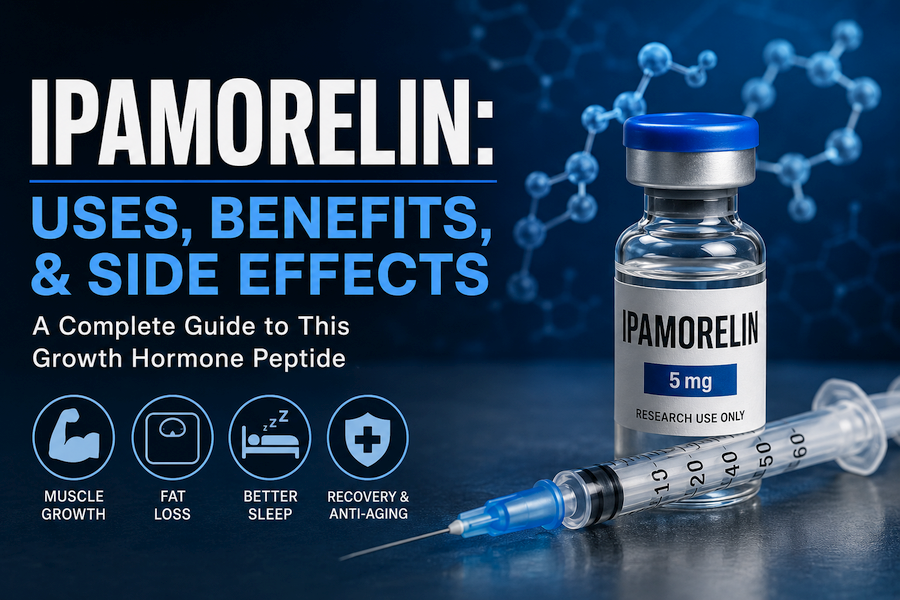
Ipamorelin is a synthetic peptide that stimulates the body’s natural release of growth hormone (GH). Unlike older growth hormone secretagogues, it appears to target growth hormone release with relatively little effect on other hormones, which is one reason it has become popular among bodybuilders, athletes, and people interested in anti-aging. Although early research suggests it may help improve recovery, support lean muscle growth, reduce body fat, and promote better sleep, Ipamorelin is not approved by the FDA for general medical use, and more human research is still needed to fully understand its long-term safety and effectiveness.
If you’ve spent any time reading about peptides, you’ve probably noticed that Ipamorelin comes up again and again. Some people describe it as one of the gentler growth hormone peptides available, while others claim it’s capable of improving everything from muscle gains to sleep quality.
The truth probably lies somewhere in the middle.
Ipamorelin isn’t magic, and it certainly isn’t a replacement for proper training, nutrition, and recovery. At the same time, it may offer some interesting benefits that researchers continue to investigate. That’s especially true because it appears to stimulate growth hormone without causing many of the unwanted hormonal changes associated with some older peptides.
What Is Ipamorelin?
Ipamorelin is a synthetic peptide that belongs to a group of compounds known as growth hormone secretagogues (GHSs). Rather than supplying growth hormone directly, it encourages your pituitary gland to release more of the growth hormone your body already produces (1).
Because of this mechanism, Ipamorelin is sometimes compared to compounds like MK-677 (Ibutamoren), although they work somewhat differently. While both aim to increase growth hormone levels, they activate different pathways and have different side effect profiles.
If you’re unfamiliar with peptides in general, you may want to read our Peptides Overview, which explains how these compounds work and why they’ve become so popular among athletes and researchers.
One feature that has made Ipamorelin particularly interesting is its selectivity. Earlier growth hormone-releasing peptides often increased other hormones as well, including cortisol and prolactin. Ipamorelin appears to have much less influence on those hormones while still stimulating growth hormone release (2).
That doesn’t necessarily make it better for everyone, but it may reduce some unwanted effects seen with older compounds.
How Does Ipamorelin Work?
Normally, your brain carefully regulates growth hormone production through several hormones and signaling molecules. One of these is ghrelin, sometimes called the “hunger hormone.” Ghrelin binds to receptors that help stimulate growth hormone release. Ipamorelin was designed to mimic some of ghrelin’s actions.
After administration, it binds to growth hormone secretagogue receptors (GHS-R1a) in the pituitary gland. This signals the body to release pulses of growth hormone into the bloodstream (3).
Those growth hormone pulses can then increase production of insulin-like growth factor-1 (IGF-1), primarily in the liver. IGF-1 is responsible for many of growth hormone’s effects throughout the body, including supporting muscle protein synthesis, tissue repair, and bone metabolism.
Unlike injecting human growth hormone directly, this process still relies on your body’s own regulatory systems. Because of that, growth hormone levels tend to rise in a more natural, pulsatile pattern.
Some researchers believe this may reduce certain risks associated with excessively high growth hormone levels, although that hasn’t been proven conclusively.
Potential Benefits of Ipamorelin
Research on Ipamorelin is still fairly limited, especially in healthy adults. Even so, the available evidence and clinical interest suggest several possible benefits. Let’s take a closer look.
1. May Increase Natural Growth Hormone Production
This is, of course, Ipamorelin’s primary purpose. Clinical studies have shown that Ipamorelin can significantly stimulate growth hormone secretion after administration (2,3).
Interestingly, researchers found that it appears to do so without substantially increasing levels of cortisol, adrenocorticotropic hormone (ACTH), or prolactin. That may sound like a small detail, but it’s actually one of Ipamorelin’s biggest selling points. Older peptides sometimes caused broader hormonal changes that weren’t always desirable.
2. May Support Lean Muscle Growth
Growth hormone plays an important role in muscle repair and recovery. Higher growth hormone and IGF-1 levels may encourage protein synthesis while helping muscles recover after intense exercise. That doesn’t mean Ipamorelin directly builds muscle by itself. Instead, it may create an environment that’s more favorable for muscle growth when combined with resistance training and adequate protein intake (4).
Many bodybuilders use Ipamorelin during bulking phases for this reason. Still, it’s worth keeping expectations realistic. Most of the dramatic muscle-building claims circulating online rely on personal anecdotes rather than controlled human trials.
For more information on peptide use in sports, check out our article on Peptides for Bodybuilding.
3. May Improve Recovery
One of the more practical reasons athletes become interested in Ipamorelin is recovery. Growth hormone participates in repairing muscles, connective tissue, and other structures after exercise. Some evidence suggests increased growth hormone secretion may shorten recovery time between intense training sessions (5).
If that’s true, it could allow athletes to train more consistently while reducing soreness. That said, recovery depends on many factors besides hormones, including:
- Sleep quality
- Nutrition
- Hydration
- Overall training volume
- Stress levels
Ipamorelin isn’t likely to compensate for poor habits in those areas.
4. May Help Preserve Muscle During Fat Loss
One challenge during calorie restriction is maintaining lean muscle mass. When calories drop too low, the body sometimes begins breaking down muscle tissue for energy. Because growth hormone tends to support protein conservation, some researchers believe Ipamorelin may help reduce muscle loss while dieting (6).
That’s one reason it’s often included in cutting protocols. Of course, preserving muscle also requires sufficient protein intake and regular resistance exercise. Without those, no peptide is likely to make much difference.

5. May Encourage Fat Loss
Growth hormone has long been associated with fat metabolism. Higher growth hormone levels appear to increase lipolysis, which is the breakdown of stored fat into fatty acids that the body can use for energy (7).
This doesn’t mean Ipamorelin melts fat away. Instead, it may modestly improve your body’s ability to use stored fat while you’re already maintaining a calorie deficit.
People sometimes expect dramatic weight loss simply from taking growth hormone-related compounds. The research generally doesn’t support that idea. Think of it as a possible supporting tool rather than a substitute for diet and exercise.
6. May Improve Sleep Quality
Many people report sleeping more deeply while using Ipamorelin. Interestingly, that claim isn’t entirely without scientific support.
Your largest natural growth hormone pulses occur during deep sleep. Some researchers believe stimulating growth hormone secretion may reinforce this normal pattern, potentially improving sleep quality in certain individuals (8).
Better sleep, in turn, may contribute to:
- Improved recovery
- Better mood
- Healthier hormone balance
- Increased daytime energy
Of course, sleep quality depends on dozens of variables, so results can vary considerably from person to person. If improving recovery is one of your goals, you may also find our article on How Sleep Quality Affects Testosterone and Recovery helpful.

7. May Support Healthy Aging
One reason Ipamorelin has attracted attention in longevity circles is that growth hormone production naturally declines with age. Some researchers have suggested that restoring more youthful growth hormone patterns might help support:
- Lean body mass
- Bone density
- Skin elasticity
- Physical performance
- Overall vitality
Those ideas are intriguing, but they’re still being investigated.
While small studies have reported encouraging findings, there’s currently insufficient evidence to recommend Ipamorelin as a general anti-aging therapy. In fact, many experts caution that simply increasing growth hormone isn’t automatically beneficial, especially over long periods.
How Is Ipamorelin Used?
Unlike oral supplements, Ipamorelin is typically administered by subcutaneous injection, meaning it’s injected into the fatty tissue just beneath the skin. Because it’s a research peptide rather than an approved prescription medication for most uses, there is no officially established dosage for healthy adults. Instead, most dosing information comes from clinical research, physician-supervised hormone clinics, and anecdotal reports within the bodybuilding community.
Many users divide their daily dose into one or two injections. Some prefer taking it before bedtime since the body’s largest natural growth hormone pulse occurs during deep sleep. Others use it after workouts, hoping to take advantage of the recovery process.
It’s worth mentioning that timing probably isn’t nearly as important as many online forums claim. While small differences may exist, overall hormone balance, sleep quality, nutrition, and training are likely to have a much greater influence on results.

Can Ipamorelin Be Stacked with Other Peptides?
Yes. In fact, stacking is fairly common. One of the most popular combinations pairs Ipamorelin with CJC-1295, another peptide that stimulates growth hormone release through a different mechanism.
The reasoning is fairly straightforward.
- CJC-1295 increases growth hormone-releasing hormone (GHRH) activity.
- Ipamorelin activates ghrelin receptors.
- Together, they may produce a stronger growth hormone pulse than either compound alone (9).
Some users also combine Ipamorelin with peptides intended to support recovery, such as BPC-157, although evidence for these combinations remains limited.
Even though stacking has become common, combining multiple peptides also increases complexity. It can become much harder to know which compound is responsible for either positive results or unwanted side effects.
Possible Side Effects of Ipamorelin
Compared with many performance-enhancing drugs, Ipamorelin is generally considered to have a relatively mild side effect profile. That doesn’t mean it’s free of risks. Because long-term human research remains limited, some side effects are well documented while others are based mainly on user reports.
Potential side effects include:
| Possible Side Effect | Comments |
|---|---|
| Injection site irritation | Usually mild redness, swelling, or soreness. |
| Headache | Often temporary and may improve with continued use. |
| Dizziness | Reported occasionally, especially early on. |
| Fatigue | Some users experience temporary tiredness after dosing. |
| Water retention | Generally less common than with direct HGH use but still possible. |
| Increased appetite | Usually milder than with MK-677 but may occur because of ghrelin receptor activation. |
| Numbness or tingling | Rare, but has been reported by some users. |
Fortunately, Ipamorelin appears less likely to raise cortisol or prolactin than many earlier growth hormone secretagogues, which is one reason it continues to receive attention from researchers (2).
Still, individual responses can vary considerably. Someone with underlying medical conditions or hormone disorders may respond quite differently than a healthy adult.

Are There Any Long-Term Risks?
This is probably the biggest unanswered question. Most available studies have been relatively short, and there simply isn’t enough long-term human research to know exactly what happens after years of continuous Ipamorelin use. That’s important because growth hormone affects nearly every tissue in the body.
Researchers continue to investigate questions such as:
- Could prolonged stimulation reduce the body’s own responsiveness?
- Might chronically elevated IGF-1 increase certain health risks?
- What happens after many years of use?
At this point, no one can answer those questions with complete confidence. For that reason alone, it’s wise to approach any peptide with realistic expectations rather than assuming it’s completely safe simply because it’s newer than older compounds.
Who Might Consider Ipamorelin?
Most people interested in Ipamorelin fall into one of several groups:
- Bodybuilders looking to improve recovery.
- Athletes hoping to support muscle growth.
- Adults interested in healthy aging.
- Individuals working with hormone specialists to address growth hormone deficiencies.
For otherwise healthy people, however, the decision isn’t always straightforward. While early research appears promising, many claimed benefits have yet to be confirmed in large, long-term clinical trials. Sometimes the excitement surrounding peptides grows much faster than the evidence supporting them.

Who Should Avoid Ipamorelin?
Ipamorelin may not be appropriate for everyone. Individuals should avoid using it—or discuss it carefully with a healthcare professional—if they:
- Have active cancer or a history of certain cancers.
- Are pregnant or breastfeeding.
- Have uncontrolled diabetes.
- Have serious endocrine disorders.
- Are taking medications that could interact with hormone therapies.
Because growth hormone influences cell growth, anyone with a history of cancer should be particularly cautious. Again, this is an area where more research is still needed.
Is Ipamorelin Legal?
The legal status of Ipamorelin depends on where you live. In the United States, Ipamorelin is not approved by the FDA for general medical use, although it may be prescribed by certain healthcare providers through specialized clinics under specific circumstances.
Many products sold online are marketed as “research chemicals.” These products are generally intended for laboratory research rather than human consumption.
Competitive athletes should also remember that Ipamorelin is prohibited by the World Anti-Doping Agency (WADA) because it stimulates growth hormone secretion (10). Anyone competing in tested sports should assume its use could result in a positive doping test.

Ipamorelin vs. MK-677
Since both compounds increase growth hormone activity, they’re often compared. Here’s a quick overview:
| Feature | Ipamorelin | MK-677 (Ibutamoren) |
|---|---|---|
| Type | Injectable peptide | Oral growth hormone secretagogue |
| Administration | Injection | Capsule or liquid |
| Appetite increase | Usually mild | Often significant |
| Cortisol effects | Minimal | May increase slightly in some people |
| Growth hormone stimulation | Pulsatile | More prolonged |
| Research history | Moderate | More extensive |
Neither compound is clearly “better.”
Some people prefer the convenience of MK-677 because it’s taken orally, while others like the more selective nature of Ipamorelin and its reputation for causing fewer appetite-related side effects. If you’d like to learn more, check out our complete guide to MK-677 (Ibutamoren), where we compare its benefits, risks, and research in greater detail.
Final Thoughts
Ipamorelin has earned a reputation as one of the more selective growth hormone-releasing peptides available today. Its ability to stimulate natural growth hormone release while having relatively little effect on cortisol and prolactin makes it especially appealing to researchers and performance-focused users.
At the same time, it’s important to keep expectations grounded. The available evidence suggests that Ipamorelin may support muscle recovery, help preserve lean mass during dieting, improve sleep quality, and modestly enhance fat loss. Those potential benefits are certainly interesting, but they don’t replace the fundamentals of good health. Consistent training, quality sleep, proper nutrition, and smart recovery habits will almost always have a greater impact than any single peptide.
Another point that’s easy to overlook is the lack of long-term research. Much of Ipamorelin’s popularity has been driven by anecdotal reports and small clinical studies. While those reports may point researchers in promising directions, they aren’t the same as large, well-controlled trials that follow people for many years.
If you’re considering Ipamorelin, it’s worth weighing both the potential benefits and the unanswered questions. For some individuals working under medical supervision, it may eventually prove to be a useful tool. For others, focusing on proven lifestyle strategies (or exploring safer, well-studied approaches to naturally support growth hormone production) may be the more sensible path.


Jim is the founder of Andro HQ and a self-taught supplement reviewer with over 12 years of personal testing experience. He has evaluated more than 150 bodybuilding products and specializes in identifying effective, science-backed alternatives to banned substances. His insights are grounded in real-world use, documented trials, and continuous experimentation in the gym. While not a licensed health professional, Jim aims to help readers navigate the often-confusing supplement market through honest, evidence-informed reviews. More about this author…