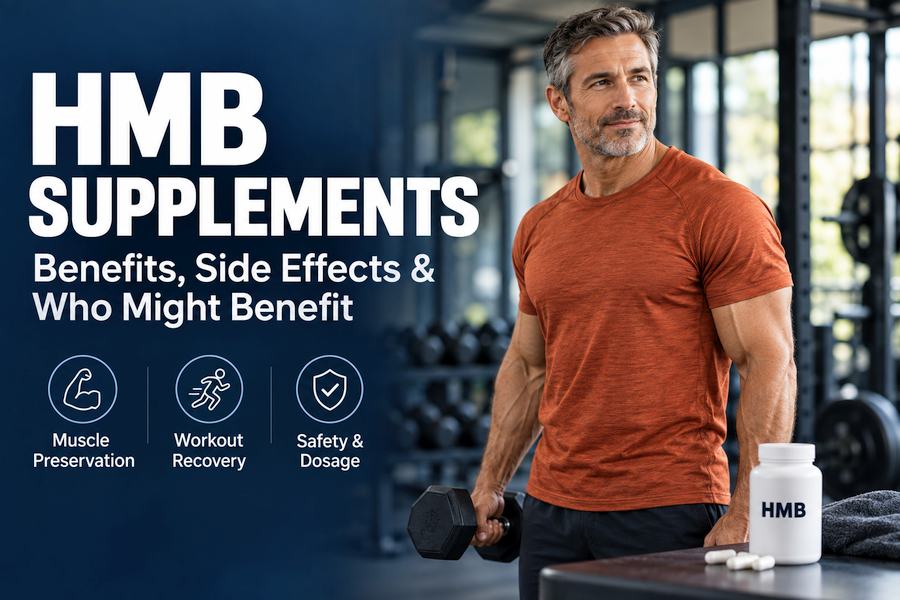
HMB is a compound your body makes from the amino acid leucine. Supplements may help limit muscle loss during inactivity and could support recovery after demanding exercise. However, extra muscle and strength gains aren’t consistent, especially in people who already train regularly. A common research dose is 3 grams daily, and adult studies generally report good tolerance. HMB is an optional tool, not a replacement for protein, exercise, or medical care. (1, 2, 3)
If you’ve looked at muscle-building supplements, you’ve probably seen HMB advertised as a way to protect your gains. Some labels make it sound like a shortcut to getting bigger without putting in much work.
The reality is more interesting—and less dramatic. HMB may have a place when maintaining muscle becomes difficult, but that doesn’t mean every guy with a gym membership needs it. Let’s look at what it does, where the evidence holds up, and when you might reasonably consider it.
What Is HMB?
HMB stands for beta-hydroxy-beta-methylbutyrate. Thankfully, you don’t need to remember that mouthful to understand the supplement.
Your body produces HMB when it breaks down leucine, an amino acid found in protein-containing foods. Only a small share of leucine becomes HMB, so eating more protein doesn’t produce the same HMB exposure as taking a supplement. That doesn’t make food less valuable; it simply means they’re different approaches. (1)
Researchers study HMB partly because early trials suggested it could reduce muscle protein breakdown during demanding training. Think of muscle maintenance as ongoing repair: your body builds proteins while also removing old or damaged ones. Preserving more tissue is one proposed benefit, although early findings need to hold up in later research. (9)
It isn’t an anabolic steroid or a hormone. There’s also no good reason to treat it as a testosterone booster; its proposed benefits center on muscle maintenance and recovery.

Does HMB Help Build Muscle and Strength?
Here’s where supplement advertising often runs ahead of the evidence. A plausible effect inside muscle cells doesn’t guarantee bigger arms or a stronger squat.
A 2020 systematic review and meta-analysis examined HMB alongside resistance training in young adults. It found no significant improvement in fat-free mass or strength compared with training without HMB. That’s a useful reality check if you’re expecting a noticeable boost from adding another capsule. (3)
The International Society of Sports Nutrition takes a more favorable view. Its position statement suggests that beginners may benefit and that results in trained athletes vary, with recovery possibly explaining some positive findings. These differences show why you shouldn’t judge HMB from one impressive study or one enthusiastic endorsement. (2)
My practical take: if you’re healthy, eating enough, and following a sensible program, HMB wouldn’t be my first purchase. Getting your training and meals right offers a more dependable foundation.
If that foundation needs work, start with protein intake for muscle growth. An optional supplement makes more sense once the basics are actually in place.
Could It Support Workout Recovery?
HMB may help recovery after exercise that causes substantial muscle damage. The National Institutes of Health notes that trained athletes may need a more demanding workout than beginners to reach the conditions where HMB could help. Even then, improved athletic performance isn’t assured. (1)
That distinction matters. A change in a blood marker of muscle damage doesn’t necessarily mean you’ll feel less sore, train better, or gain more muscle over several months.
If you’re returning after a long break, gradually increasing your workload is still the sensible move. Don’t use a recovery supplement as permission to double your training volume overnight.
Before blaming slow recovery on a missing ingredient, consider your schedule and sleep quality and recovery. A supplement trial is harder to interpret when your sleep and training change every week.
HMB and Age-Related Muscle Loss
Older adults are a major focus of HMB research, particularly those who have low muscle strength or struggle to stay active. But the findings don’t support a blanket recommendation for everyone over 50.
A 2025 review of ten trials found possible improvements in handgrip strength and overall physical function when HMB accompanied resistance training. It didn’t find significant benefits for several other measures, including limb muscle mass. Half the trials had a high risk of bias, which lowers confidence in the results. (4)
A larger 2026 review, covering 13 randomized trials, found no clear added benefit for muscle mass, strength, or fat mass in adults aged 50 and older who performed resistance training. Its authors advised against recommending HMB routinely as an addition to structured exercise. (5)
The difference between these reviews may reflect the studies and outcomes they included. Still, being older doesn’t automatically make you a likely responder. If you’re comparing workout supplements for men over 40, keep your actual needs ahead of age-based marketing.

Preserving Muscle During Inactivity
HMB’s potential role during inactivity deserves separate attention. Preventing muscle loss during bed rest is a different goal from adding muscle to an already well-trained body.
In a small randomized trial, researchers studied older adults during ten days of complete bed rest. Those taking calcium HMB lost less lean body mass than the placebo group in the reported analysis. However, the study was small, most participants were women, and one participant was excluded from that analysis. Clear improvements in physical function weren’t demonstrated. (6)
That’s promising evidence, but it doesn’t prove HMB prevents muscle loss in every injury or illness. A healthy volunteer confined to bed isn’t the same as someone recovering from major surgery.
If illness or an injury limits your activity, ask your clinician or dietitian whether HMB fits your recovery plan. It should accompany appropriate nutrition and rehabilitation, rather than become a substitute for them. Your recovery plan should reflect your medical needs.
Who Might Benefit Most?
Based on the available research, the strongest reasons to discuss HMB are difficulty maintaining muscle during inactivity or a broader risk of muscle decline. Someone recovering from an illness may have a different reason to consider it than a healthy lifter chasing faster gains. (5, 6)
Early trials in unfamiliar training settings found benefits, although later reviews haven’t consistently confirmed extra gains. Experienced lifters who already eat well and train regularly have less convincing reasons to expect extra muscle or strength. (3, 9)
For weight loss, don’t assume HMB will protect every ounce of muscle during an aggressive diet. Keeping the calorie deficit reasonable, maintaining resistance training, and meeting protein needs should come first.
HMB Dosage and Supplement Forms
Three grams per day is a commonly studied amount, including in early training trials. (9) One approach is to split it into three 1-gram servings; check the serving size carefully, since one capsule may contain much less than a full daily dose. There’s no established reason to assume that doubling the amount doubles the benefit. (1)
You’ll mainly find calcium HMB and free-acid HMB. Some studies suggest faster absorption with the free-acid form, but findings are mixed. Faster entry into the bloodstream doesn’t establish better long-term results, so a higher price alone doesn’t justify choosing it. (2)
Also check the calcium content if you’re using calcium HMB, particularly if you take other calcium-containing products. Keep a record of what you’re taking so your clinician can review the complete picture.
Side Effects and Safety
HMB generally appears well tolerated at studied doses. Short-term adult research hasn’t identified a consistent pattern of adverse effects at 3 grams daily. (1)
A 12-month trial of HMB combined with vitamin D also found no clinically significant changes in kidney or liver function markers and no supplement-related increase in adverse events. That’s reassuring, although a study of a combined product can’t answer every safety question about HMB alone. (7)
Don’t read good tolerance as proof of universal safety. People with kidney disease, significant medical conditions, or multiple prescriptions should get individualized advice. Pregnancy, breastfeeding, and use in children also deserve caution because adult exercise studies don’t establish safety for these groups.
If you develop nausea, diarrhea, or another new symptom after starting a product, stop and seek advice. The cause could be HMB, another ingredient, or something unrelated; you don’t have to push through it.
Is HMB Better Than Creatine?
For strength and repeated high-intensity exercise, creatine has a stronger evidence base. HMB’s proposed role focuses more on limiting muscle breakdown and supporting recovery, so the two shouldn’t be treated as interchangeable. (1)
Our discussion of creatine and testosterone can help you separate performance claims from hormone claims. You also don’t need to combine both supplements just because a product sells them together.
If you try HMB, choose a product with a clearly stated dose and independent quality testing. Testing can help verify ingredients and contamination control, but it doesn’t prove you’ll get stronger or build muscle. (8)
Keep expectations modest and track something meaningful, such as strength, daily function, or recovery. HMB may fit a specific need, but simply taking it isn’t evidence that it’s helping.



Jim is the founder of Andro HQ and a self-taught supplement reviewer with over 12 years of personal testing experience. He has evaluated more than 150 bodybuilding products and specializes in identifying effective, science-backed alternatives to banned substances. His insights are grounded in real-world use, documented trials, and continuous experimentation in the gym. While not a licensed health professional, Jim aims to help readers navigate the often-confusing supplement market through honest, evidence-informed reviews. More about this author…