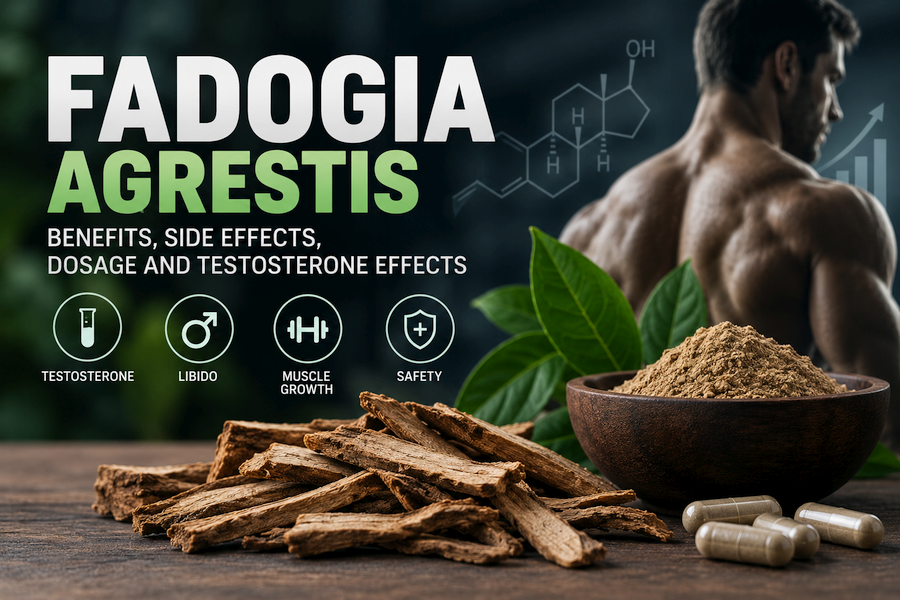
Fadogia agrestis is an African plant that has become popular as a natural testosterone and libido supplement. Animal research suggests it may increase testosterone and sexual activity, but there are currently no good human clinical trials confirming these benefits. More concerning, animal studies have also found signs of testicular, liver, and kidney toxicity. For now, Fadogia is an interesting but poorly studied supplement that deserves more caution than the hype around it may suggest.
Fadogia agrestis went from being a fairly obscure African medicinal plant to one of the more talked-about natural testosterone boosters almost overnight. Much of that attention comes from podcasts, social media, fitness influencers, and its frequent pairing with Tongkat Ali.
The basic sales pitch sounds appealing: take an herbal extract, raise testosterone naturally, improve your sex drive, and perhaps get better results in the gym. There’s just one problem. Human research hasn’t caught up with the hype.
Fadogia does have some interesting animal research behind it, so it isn’t fair to dismiss the plant as completely baseless. Still, the same research also raises safety questions that supplement advertisements don’t always mention.
What Is Fadogia Agrestis?
Fadogia agrestis is a shrub belonging to the Rubiaceae family. It grows in parts of Africa, including Nigeria, where preparations made from the plant have traditionally been associated with sexual function and male vitality.
The stems are the part most often discussed in scientific research. Researchers have identified several types of plant compounds in Fadogia, including alkaloids and saponins (1).
Today, you’ll find Fadogia extracts sold in capsules and included in multi-ingredient testosterone formulas. It has also become particularly popular when combined with Tongkat Ali.
The modern reputation of Fadogia, however, rests heavily on a surprisingly small number of animal experiments.

Does Fadogia Agrestis Increase Testosterone?
This is easily the biggest reason men take Fadogia.
A frequently cited 2005 study gave male rats Fadogia agrestis stem extract at doses of 18, 50, or 100 mg per kilogram of body weight. Researchers reported significant increases in blood testosterone concentrations across the treatment groups. The effect appeared to increase with the dose (1).
That sounds impressive at first. The problem is that rats aren’t humans. Animal research is useful for identifying possible biological effects, but you can’t assume the same effect will occur in men taking a supplement.
As of now, we don’t have convincing randomized human trials showing that Fadogia reliably raises total testosterone, free testosterone, or other androgen markers.
That’s an important distinction. There are supplements with at least some human evidence behind them, while Fadogia remains largely experimental. You can compare it with some better-known ingredients in our guide to the best testosterone supplements.
For men who suspect they genuinely have low testosterone, supplements also shouldn’t replace proper testing. Symptoms such as poor libido, fatigue, reduced muscle mass, and mood changes can have many causes. Our guide to low testosterone symptoms, causes and treatments explains this in more detail.
Fadogia Agrestis and Libido
The libido evidence is a little more interesting, although it still comes from animals. In the same 2005 experiment, male rats receiving Fadogia showed changes in several measures of sexual behavior. They mounted more frequently, had more intromissions, and showed shorter delays before mounting and intromission compared with controls (1).
Researchers suggested that the rise in testosterone could partly explain these effects. This supports Fadogia’s traditional reputation as an aphrodisiac, but again, there’s a big gap between an animal experiment and saying that a capsule will increase a man’s sex drive.
Libido is complicated anyway. Testosterone matters, particularly when levels are low, but sleep, stress, medications, relationship factors, estrogen, prolactin, and general health can all influence sexual desire.
So, while Fadogia may have aphrodisiac properties, we don’t yet know how noticeable or reliable those effects are in humans.

Can Fadogia Help Build Muscle?
You’ll sometimes see Fadogia promoted as a muscle-building supplement because of its supposed testosterone effects. The logic isn’t completely unreasonable. Testosterone plays an important role in muscle protein synthesis, recovery, strength, and body composition.
If a supplement meaningfully increased testosterone in humans, it might potentially support training results. But that’s a pretty big “if.”
There isn’t good evidence showing that Fadogia increases lean muscle mass or strength in resistance-trained humans. Even a modest change in testosterone within the normal physiological range doesn’t automatically produce dramatic muscle gains.
Fadogia certainly shouldn’t be viewed as a natural steroid. If your main goal is building muscle, adequate calories and protein, progressive resistance training, sleep, and proven supplements such as creatine have much stronger evidence behind them.
Fadogia Agrestis and Male Fertility
This is where the story gets more complicated. You might assume that a plant reported to raise testosterone would automatically be beneficial for reproductive health. Animal research suggests things aren’t that simple.
In one study, male rats received Fadogia extract daily for 28 days. Researchers observed changes in several markers of testicular function and concluded that the extract produced adverse effects on the functional capacity of the testes (2).
Some recovery occurred after supplementation stopped, particularly among rats receiving the lowest dose, but the findings still deserve attention. This doesn’t prove that Fadogia damages human fertility. We simply don’t have the clinical data needed to say that.
Still, I’d be especially cautious about using it if you’re actively trying to conceive. “Raises testosterone in rats” and “improves men’s fertility” are two very different claims.
Fadogia Agrestis Side Effects and Safety
One frustrating thing about Fadogia is that we don’t have good human trials documenting its side-effect rate. The animal research, however, gives us reasons not to assume that “natural” means harmless.
Researchers giving male rats Fadogia extract for 28 days found biochemical changes involving the liver and kidneys. Their findings suggested oxidative damage and disruption of cell membrane integrity in liver and kidney tissue (3).
Interestingly, the animals didn’t show obvious signs of poisoning or organ enlargement. That’s worth noting because toxicity isn’t always accompanied by dramatic outward symptoms. Combine those findings with the testicular changes discussed earlier, and Fadogia’s long-term safety becomes a legitimate question.
Potential areas of concern include:
- Liver function
- Kidney function
- Testicular function
- Fertility
- Unknown interactions with medications
- Uncertain effects from prolonged or high-dose use
None of this establishes that typical supplemental doses cause organ damage in humans. The problem is that we don’t have enough evidence to confidently rule it out either.
What Is a Typical Fadogia Agrestis Dosage?
There’s currently no scientifically established human dosage for Fadogia agrestis. That’s probably the most useful thing to remember when you see precise dosage recommendations online.
Commercial products vary considerably. For example, a Fadogia product recorded in the NIH Dietary Supplement Label Database supplied 1,000 mg per two-capsule serving (4). But a manufacturer’s suggested serving isn’t the same thing as a clinically proven safe or effective dose.
The animal studies used doses based on body weight, and you shouldn’t simply convert those numbers into a human dose and start experimenting. Differences in metabolism, extract composition, concentration, and preparation make that approach unreliable.
Until controlled human studies establish an effective dose and safety range, claims about an “optimal” Fadogia dosage are mostly speculation.
Should You Cycle Fadogia?
You’ll often see people recommending Fadogia cycles, such as taking it for several weeks and then taking time off. There’s no clinical evidence establishing an ideal cycling schedule.
Cycling might sound sensible as a way of limiting continuous exposure, but we can’t say that taking breaks prevents the possible testicular, liver, or kidney effects seen in animal research. That’s an assumption rather than a proven safety strategy.
Anyone taking Fadogia despite the uncertainty should be particularly wary of high doses, long-term continuous use, or combining multiple poorly studied ingredients.

Fadogia vs. Other Testosterone Supplements
Fadogia is unusual because its reputation has grown much faster than its research base. Tongkat Ali, for example, has human research investigating testosterone, stress, and male sexual health.
Shilajit has also been studied in humans, including research examining androgen levels. Even something like D-aspartic acid has considerably more human research, although its testosterone-boosting results have been inconsistent.
That doesn’t mean these supplements are guaranteed to work, but it does point out how thin the human evidence for Fadogia is currently.
Is Fadogia Agrestis Worth Taking?
Fadogia is one of those supplements where the answer depends heavily on how comfortable you are with uncertainty. There’s enough animal research to make its reputation as a testosterone and libido herb scientifically interesting. The early results aren’t just internet buzz – researchers really did observe increased testosterone and sexual behavior in male rats (1).
But we have to consider the whole body of evidence, not just the exciting part.
Other experiments found changes associated with impaired testicular function and possible liver and kidney toxicity (2,3). Meanwhile, convincing human trials demonstrating testosterone, libido, muscle, or fertility benefits are still missing. For me, that shifts Fadogia into the “promising but unproven” category rather than the “proven testosterone booster” category.
Men with symptoms of low testosterone are better served by getting hormone levels checked and looking at basics such as sleep, nutrition, exercise, stress, and proven testosterone boosting supplements before relying on an experimental herb.
Fadogia agrestis may eventually turn out to have useful applications. It may also turn out that the effective dose is too close to a dose that creates unwanted effects. Until human research gives us those answers, a little skepticism is probably healthier than automatically jumping on the hype wagon.


Jim is the founder of Andro HQ and a self-taught supplement reviewer with over 12 years of personal testing experience. He has evaluated more than 150 bodybuilding products and specializes in identifying effective, science-backed alternatives to banned substances. His insights are grounded in real-world use, documented trials, and continuous experimentation in the gym. While not a licensed health professional, Jim aims to help readers navigate the often-confusing supplement market through honest, evidence-informed reviews. More about this author…